
CRPGs are weird. For the last twenty years, RPGs have been doing everything they can to become more approachable: less reading, fewer stats, simpler combat, less choices, and way bigger explosions.
Meanwhile CRPGs looked at that trend and just went: "Nah". Dialogue trees became forests. Character builds ballooned in complexity. And some of these games now expect you to read more than some people will in their entire life! You would think that this would completely doom the genre to irrelevance, but instead it's more popular now than it has been in decades.
And after playing through the Warhammer 40k: Dark Heresy beta, I found myself wondering why that's the case. What actually makes a great CRPG? And does all that complexity really make the games better, or have we all just Stockholm Syndrome'd ourselves into enjoying spreadsheets?
Video version of this retrospective (~14 minutes)
Is it the Writing?
At first the answer felt obvious - it's all about the writing, complexity be damned. Because Dark Heresy is one of those games where I've spent entire sessions just talking to anyone with a mouth - and even people without one! No combat. No exploration. I just roleplayed the world's most obnoxious man and slammed a thousand questions at anyone unfortunate enough to cross my path. And not because I had to, but because I wanted to.
And why? Because Dark Heresy is absolutely packed with fascinating freaks to unpack. One of my favorite weirdos is Hecatus Prime, an Adeptus Mechanicus bureaucrat that's more spreadsheet than man. In real life talking to him would probably drive you into a murderous rage.
But in game? I happily stood there listening to the talking toaster ramble until he physically ran out of things to ramble about. Because that's one of my favorite things about CRPGs in general. Learning about strange worlds by talking to the strange people who inhabit them, and Dark Heresy is fantastic at that.
Even random poop-shovelers scraping a miserable existence at the bottom of a hive city feel like actual people. Horribly indoctrinated, rage-filled hate-machines... but people nonetheless! Warhammer 40k is one of the rare few settings where you'll find priests stapling their eyes open because their god's into some kinky stuff. And apparently so am I, because I spent 10 minutes annoying that man with questions.
So maybe that's the answer. Maybe great writing is really all a CRPG needs. Except, there's one small problem. Books have great writing too.
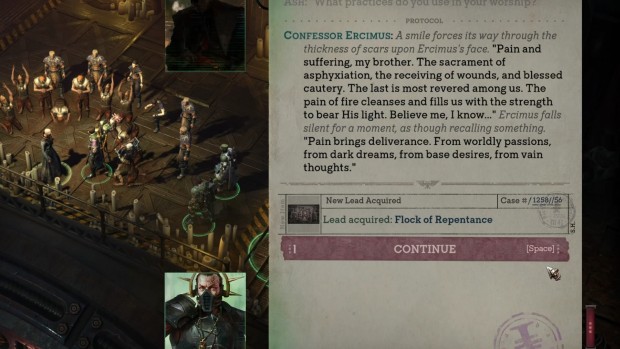
Warhammer 40k - Everything is the worst it can possibly be, always
Is it the Story?
And memorable characters can only carry a game so far. Eventually they need a story worth caring about, and this is where Dark Heresy really got its hooks into me. I won't spoil the main plot, but I will talk about one of my favorite quests from the beta.
As an Inquisitor you're sent to investigate a string of disappearances at the very bottom of a hive city - which, if you don't know much about Warhammer 40k, is basically like trying to figure out where someone vanished in the Mariana Trench. It's a place so far below the surface that the world above has basically forgotten it exists. And yet, it's full of people. People living miserable lives, tirelessly toiling away for masters that simply don't care.
But do you know who cares? Me! Because I absolutely love a good hellpit. It's far more interesting to explore than a generic fantasy world where Elves and Dwarves squabble over beard length. Where else can you round a corner from a perfectly normal looking street, and then stumble upon a group of people butchering a gigantic, hyper-mutated leviathan right in the middle of the road.
And for me, getting dropped into a world like this that feels genuinely alien - and then slowly piecing together how it functions - is an absolute delight.
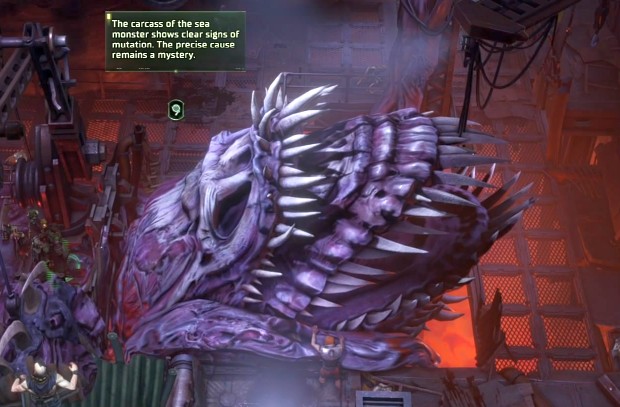
Yummy!
And yet, despite all that, it wasn't the world that got me hooked on Dark Heresy. It was the investigation itself that made me go from "Eh, I'll just try the beta for a little bit" to losing 20+ hours over a single week.
Throughout the entire quest I was fed a steady diet of lies, half-truths and carefully crafted misdirection. Nobody actually wanted to help me which, considering that the Warhammer Inquisition is somehow even more likely to light you on fire than the real life one, makes a lot of sense. Because of this I found every conversation to be important since there's a lot you can learn just from what people refuse to talk about.
And unlike most RPGs, Dark Heresy never points you towards a solution. There isn't a glowing quest marker you can follow from one clue to another. Instead the game throws a conspiracy board at you that looks like it was stolen from Charlie in Always Sunny, wishes you good luck, and then just leaves the room while laughing maniacally.
But you know what? I'm into that. This is one of the rare non-puzzle games where I felt like an actual detective. A bit of an insane one, sure, but you try to make sense of this whole mess without going a little bit mad!
And I think that's where Dark Heresy really got me. Not the mystery itself, but the uncertainty behind it.
Dark Heresy is a game about the Inquisition, so everyone has an agenda, everyone is hiding something, and office politics are like walking across a minefield... sometimes literally. So learning who you can trust, untangling the web of lies and making alliances - as fleeting as they may be - made finishing the investigation far more satisfying than I ever expected from what looked like a fairly simple introductory quest.
So maybe that's the answer then? Get some fun characters, an interesting setting and throw in a compelling mystery. It's certainly a big part of it... but then again, Lord of the Rings has all of this too, and you wouldn't call that a great CRPG. So there's definitely more to it.
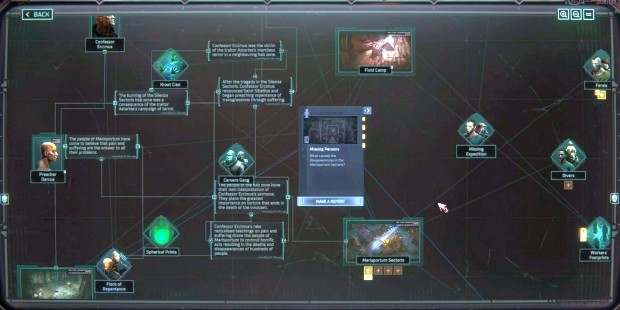
The investigation board is insanely big, but that's what makes it fun
Is it the Customization?
But there is one thing Lord of the Rings doesn't have. It never asks how many points you have in Athletics before deciding if you'll jump a gap or break every bone in your body.
Like any good CRPG, Dark Heresy - even in this early form - gives you an absurd number of ways to build your character. You decide how they fight, what they're good at, what they know, and even what sort of Inquisitor they'll become. You can roleplay a dogmatic zealot whose answer to every problem is 'shoot it', or the sort of person who sees an ominous glowing chest and then thinks: "I should go poke that!".
And I love that sort of stuff. I spent half an hour making my smooth-talking Psyker, and it was all worth it in the end. My abilities had fun synergies, I could talk my way out of trouble almost as often as I stumbled into it, and with every level up I felt like I was getting closer and closer to the exact character I first imagined.
But then I had to do that for another guy. And then another. And then another. And then another.
I completely understand why Owlcat lets you customize your companions to such an extent. It's a deep and intricate game, and so plenty of people love squeezing every last drop of efficiency they can out of their party. But for me, this is where the CRPG complexity hits the brick wall of annoyance.
I really don't care what flavor of cereal my companions are having for breakfast. I'd rather just assign them roles like "you're the tank guy", "you're the sniper" and "you're the emotionally unstable one". Then let the game figure out the fiddly bits unless I specifically tell it not to.
That way people who love micromanaging every stat can go crazy with it, while the rest of us can get back to solving murders and asking weirdly personal questions to people we've just met.
Because I think that's where the complexity really earns its place. When it's helping me shape my characters, my choices and the story - it's fantastic. But when it's making me spend twenty minutes to decide if Steve should be slightly more resistant to farts or slightly better at lighting fires... maybe we've gone a little too far.
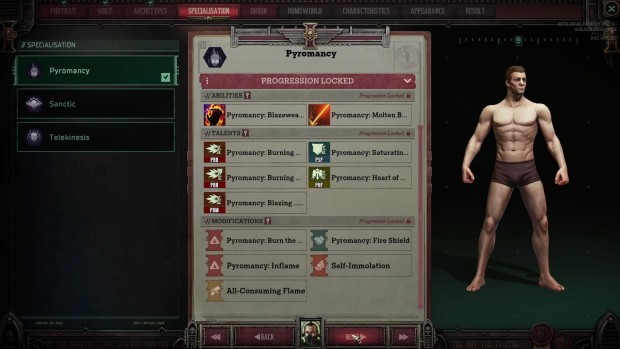
This is just a small portion of what's out there
Is it the Combat?
Of course, all those builds would be pretty meaningless if the combat didn't actually ask anything of you. Why spend 30 minutes making the perfect Psyker if every fight can be won by sneezing in the enemy's general direction?
Take our good friend Hecatus Prime. Before he'll even agree to talk to you, you first have to teach his underlings some manners... but not too much, because if you damage his precious machinery he'll go full Karen on you.
So now you're stuck fighting enemies that literally grow on trees. All of them are roided out robo-freaks that can obliterate you if they ever hit you, and you're expected to win while treating all of them like priceless museum exhibits.
Would it surprise you to hear that I died here? A lot.
It took me five attempts - at normal difficulty - to get through the encounter. And somewhere around restart number three, while a rustbucket was sawing its way through my entire frontline, I genuinely couldn't decide if I was having a blast... or just getting blasted.
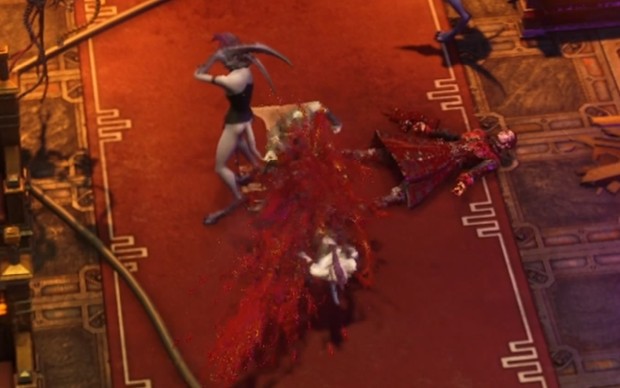
Dark Heresy's combat gets really nasty really quickly
Because on one hand, Dark Heresy's combat is fantastic. Every fight is handcrafted. You're never forced to push through a horde of rats because the designers felt the street was a bit empty. Every battle has a reason to exist and it's own little twist that asks something different of you. And as someone that absolutely despises busywork, I love that about Dark Heresy.
On the other hand, it's also really difficult. Which I don't mind on its own, but this is where the complexity starts to creep back in like some kind of monster.
Because suddenly, you can't really afford to have a companion whose only contribution is moral support and a flamethrower that shoots sparkles. Everyone needs to be a finely tuned war crime machine, because otherwise you're probably not making it through the encounter alive. Which means crunching numbers, planning builds, and reading so many tooltips you'll forget the ones at the start by the time you reach the end.
But while wrestling with all that, I actually stumbled upon the answer I was looking for the entire time.
You see, Dark Heresy lets you customize every part of its difficulty. You can make enemies weaker or stronger, turn your party into superheroes, tweak how skill checks are handled, and just kinda fiddle with everything. So if you're here purely for the story, you can just give the enemies noodle arms and kick back and relax. And if you want every encounter to feel like some deranged Yu-Gi-Oh style death game where one bad decision can ruin everything, you can do that as well. You shouldn't. But you can.
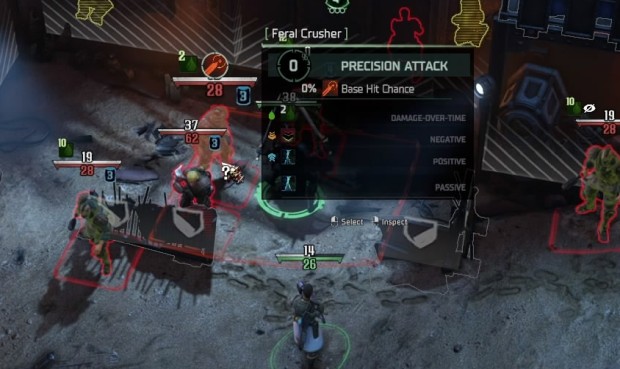
Maybe I pushed things a little too far...
What Truly Matters
And I think that's the trick. The writing, the story, the builds and the combat are all things that make a CRPG fun, but it's the choices that make one truly great. More specifically, it's the choices that actually matter. Choices that aren't just another line of dialogue before putting you back on the same path, but rather choices that genuinely shape your own version of the story.
If in Dark Heresy you make a character that's as charismatic as a penis drawing on a bathroom wall, you're going to have a much different adventure than someone who created John Warhammer. If you play as a dogmatic Inquisitor that's all about 'shoot first, ask questions never', you're going to have very different friends than someone who's willing to hear the aliens out first.
And that's why all this complexity makes sense. Every stat, every dialogue option, every build choice, every weird little system - they're all there so the game can react to you. But at the same time, I don't think the player necessarily needs to see all of it. They just need to feel like the world remembers what they did, and changes because of it.
And I think that's what makes a truly great CRPG. Not complexity for complexity's sake, but complexity in service of meaningful choices. The freedom to build your own character, to solve problems your own way. Because when a game manages that, all the reading, all the systems and all the walls of numbers and stats just kind of fade into the background. They stop feeling like homework, and instead become the reason your adventure is unique and personal.
And after twenty odd hours with the Dark Heresy beta, I think Owlcat genuinely gets it. Now if they would just release the bloody thing... because honestly, I don't know how much longer I can wait!