
Imagine being stuck in a 47-minute time loop where the main way to push forward is through therapy sessions. That's Rue Valley - a psychological RPG that's as much about solving a mystery as it is about confronting your own crippling anxiety. It wears its Disco Elysium influences proudly, yet still manages to carve out its own identity through intimate, grounded storytelling.
And while the pacing hits a wall in the middle, Rue Valley is rich with deep, emotional stories about mundane people buckling under the weight of ordinary problems - stories that feel very real and uncomfortably familiar. I'm sure we've all had sleepless nights where we just stared at the ceiling wondering where our lives are going, and Rue Valley does a tremendous job of exploring all of those mixed emotions.
Video version of this review (~12 minutes)
Live life 47 minutes at a time
Appropriately enough, the story begins with our main character - Eugene Harrow - visiting a therapist for the very first time in a small, middle-of-nowhere town. And not of his own volition either, as you very quickly figure out. Eugene is carrying a lot of emotional baggage thanks to a series of incidents that get revealed as the story progresses, so at the very start he's basically checked out from life, just halfheartedly going through the motions.
The character creation system does a great job of exemplifying this. You don't start by defining your strengths or choosing your preferred way of fighting. Instead you start choosing which flaws and insecurities will plague you for the rest of the game. Maybe you're overly dramatic, arrogant, or so socially awkward you can't even manage small talk without panicking.
These little quirks shape how your character responds to the world, and often even force you to take the worse, self-destructive options because your pride won't allow you to do things the normal way. This sort of thing was great in Disco Elysium, and for the most part it works just as well in Rue Valley. It gives you a real sense of who your Eugene is as a person, without having to spend too much time psychoanalyzing him.
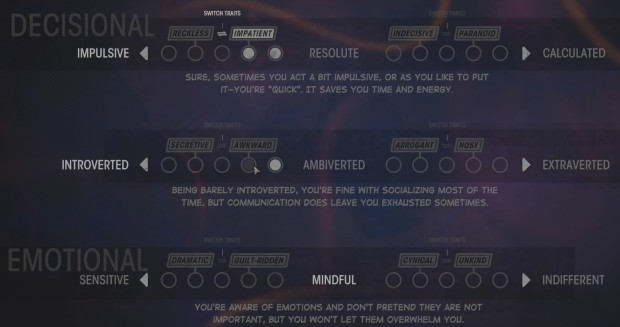
It's not every day that you see a 'How much do you suck?' screen
The definition of awkward
For example, early on you're met with a receptionist that's busy with a phone call, and the entire 5-minute section is you trying to very, very awkwardly figure out a way to get her to pay attention to you. I eventually did what I would do in real life, which is whip out a phone and start doing something - anything - just to avoid dealing with being ignored. It's such a great little human moment that even before the more magical aspects kicked in, I was already on board with Rue Valley.
Mechanically, it plays like a point-and-click adventure - you're exploring locations, solving simple puzzles, and trying to softly manipulate people through dialogue. It's not about reflexes or complex systems, but about piecing together clues and navigating a web of surprisingly complex characters.
But then the big twist happens. As soon as the clock hits 8:47 PM a gigantic explosion will devour the sky and you will jolt awake at 8PM during your therapy session with Dr. Finck. Whoever thought up this idea is a genius, because starting each loop by talking to a therapist who slowly helps you unravel your inner turmoil is such a great way of progressing your character despite being essentially stuck.
Things get even more interesting when you learn that there is another - a seemingly insane person who is able to ignore the rules of the loop and do whatever he wants. Has he been stuck here longer than you? Is that why he's so reckless? Whatever the case may be, you need to figure out who he is, how he's able to defy his fate, and how you too can escape the Groundhog Day.
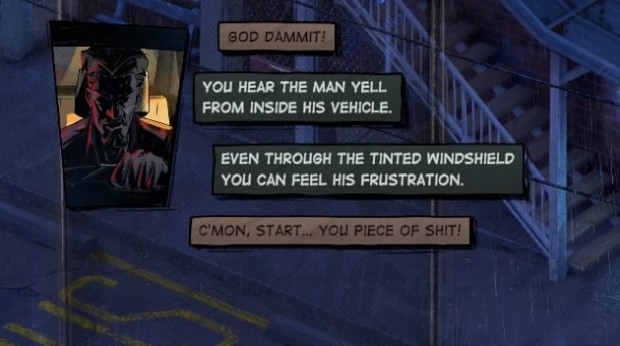
Your fate is in the hands of a complete lunatic. Hooray!
Ordinary people are fascinating
What follows next is a frantic adventure across a small town where not only everyone knows everyone, but where small businesses are often separated by kilometers of empty desert. A serious problem when all you have is 47 minutes to work with. Sometimes you have to walk for so long that you’ll only have a minute or two to actually complete your objective, which really helps put you into Eugene's headspace. You're not just watching him slowly lose his mind as he's stuck repeating the same routine, you're feeling those exact same creeping frustrations yourself.
But each time you learn a little bit more, which lets you manipulate events in your favor and learn details that people wouldn't normally share with complete strangers. And that's my favorite part of Rue Valley - slowly peeling away the layers of these fascinating characters and learning what makes them tick. The fact that they're all ordinary people just makes it more compelling to me, because the drama surrounding their lives is the same sort of stuff most of us have seen play out in real life.
Unfortunately, Rue Valley doesn't take this concept far enough. You can only really talk to people when they’re directly involved in one of your... shall we say, quests. And that’s a shame, because I would’ve loved the chance to bring up details I learned in previous loops just to see how they'd react. After all, one of the best parts of a time loop story is that moment when you manage to actually convince someone that you're not pants-on-head insane.
Or even just talk to get a bit more information out of them, because I found the characters so instantly likable that I needed to know more about them. Yet sadly, they are there purely to fulfill a function and then step aside, which feels like a real missed opportunity in a game that’s otherwise so focused on analyzing what motivates humanity to push forward despite all the hardship.
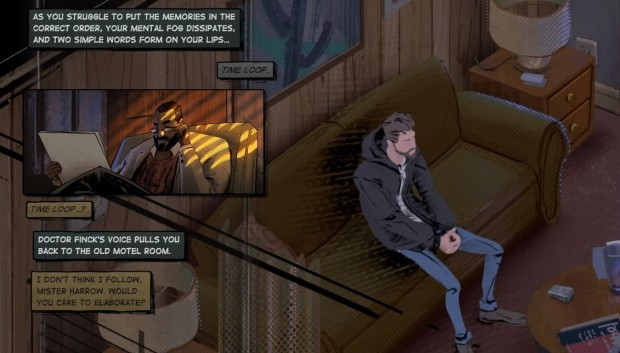
I was so close to greatness, but Rue Valley never lets you get there
Overcome your flaws
And speaking of pushing forward, most of your breakthroughs will happen when you manage to link different ideas within your mental map into a single, coherent intention - something that always reminded me of the Conspiracy Charlie meme from Always Sunny. But in order to actually act on these plans you'll need to find sufficient motivation as poor Eugene is at rock bottom and needs a gentle reminder that life is still worth living. So you'll occasionally have to stop to smell the flowers, take a leak in a river, or just zone out playing video games for the whole loop. Whatever it takes to build enough motivation to tackle the next big obstacle.
All of this is influenced by status effects that can range from crushing depression all the way to a soggy sock. Your mood naturally affects your behavior, and if you're miserable you're probably not going to make the best, most rational decisions. Which again gives you great insight into who Eugene is as a person and what drove him into his dissociated state, while also reframing you - the player - as his will to live slowly trying to guide him back into the light.
Which is why I'm sad to say that Rue Valley, again, doesn't explore this idea to its fullest. It starts off strong with you buckling under the weight of your failures and having to scramble to do even the most basic things. But after the first few hours, Eugene becomes so obsessed with the mystery that his emotional struggles just fade into the background. The system is still there, but it loses the emotional edge that made the opening hours so mesmerizing.
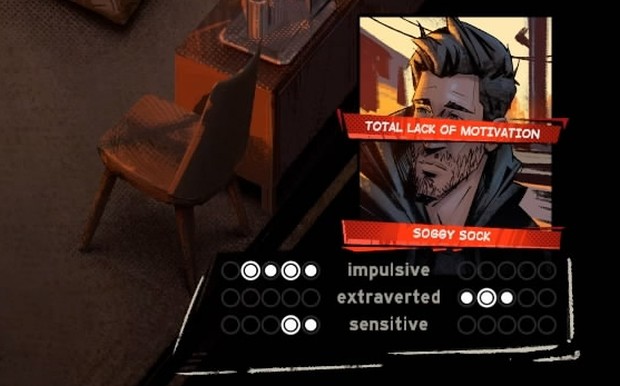
Sometimes your mood is so bad you can't really do much other than just survive
The great divide
Just as mesmerizing as the visuals. Rue Valley has this detailed comic book style that gives every location so much character. I especially love the Pixar-style traveling scenes where your character is hunched over in his tiny car while energetic jazz blasts into your ears. It's such absurd imagery that I can't help but crack a smile every time I see it.
And I saw it a lot because trying to solve the big mystery requires a lot of repetition, which is where Rue Valley suffers the most. The entire mid-game has you spending actual, real-life hours just reading dry journals, and it absolutely murders the pacing. It's not like you're solving complicated puzzles either. By this point the game is almost entirely linear, so you're just following your quest objectives while repeating the same sequences and dialogues over and over again.
It's such a strange narrative detour because the writing is otherwise highly engaging. Whenever I was talking to the characters or dealing with the big mystery I was glued to my chair. Even the more psycho-analytical conversations with the therapist were compelling, as Dr. Finck's methods are as smooth and comforting as his voice. I always looked forward to talking to him after a big breakthrough, because he never failed to share some sage advice, but without ever sounding pretentious.
So it’s baffling how the game stops you dead in your tracks to silently read random nonsense about characters who don’t matter, when the actual characters you care about could've been fleshed out further instead. Thankfully, things do start to pick back up again towards the end.
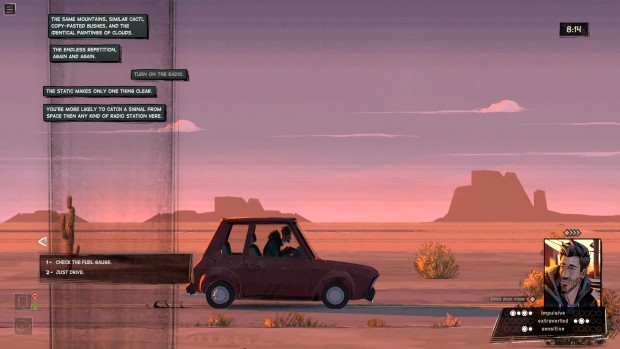
Rue Valley has an awesome vibe to it, especially while driving
All good things come to an end
I obviously won't go into details to avoid spoilers, but what I will say is that the ending is appropriately emotional for a game so focused on overcoming mental health issues. Eugene not only solves the mystery at the center of the time loop, but in the process confronts his own demons and finally figures out his place in the world.
Some people might find the ending to be a bit anticlimactic as it's not a big, bombastic action scene where everything is revealed in the final hour, but I actually like that. Because ultimately, it's Eugene's journey that matters more than the mystery. How you dealt with being stuck in a time loop, how you overcame its challenges, and how you changed throughout the adventure - that's the true story of Rue Valley. And the fact that it ends almost exactly the way it began is such a lovely, poetic capstone to the whole journey.

It's cliché, but it really is about the journey, not the destination
Is Rue Valley worth playing?
Which leads us to the hardest question of them all - should you play Rue Valley? I'm going to say yes, but with a serious caveat. When it's good, it's genuinely brilliant - the characters, the themes, and Eugene's journey left a real mark on me. But that middle section is so sluggish and repetitive that it nearly made me quit. So if you're diving in, steel yourself for a few hours of tedious busywork as the highs are high enough that it's well worth pushing through.
What I do know for certain is that I will be keeping an eye on Emotion Spark Studio. Rue Valley, even with all of its flaws, was a remarkable first effort. If the team learns some valuable lessons from it, and really leans into all of Rue Valley's strengths, I have a feeling their next game will be something truly special.