

Lex Imperialis is Rogue Trader's second major story expansion, and it tackles the most terrifying nightmare in all of Warhammer 40k - Imperial Bureaucracy! Over the course of its roughly 16 hour campaign you'll chase down shady conspiracies, team up with a grizzled Arbites agent and his adorable murder-mutt, and try your hand at the new Overseer class that lets you command a variety of weird but wonderful minions like the Psyber-Raven.
So, where does Lex Imperialis shine? Where does it stumble? And most importantly - should you play it?
Video version of this review (~13 minutes)
Well, before we dive into the deep end, let’s address the real burning question. The one this whole review hinges upon: Can you pet the dog?
And the answer is yes - you can indeed pet the dog! Though in true Rogue Trader fashion, you’ll need to pass a skill check or risk getting your fingers chewed off. But hey, that’s a small price to pay for giving the good robo-dog a well-earned head pat.
How buggy is it?
Alright, now let's talk bugs. The technical kind, not the alien ones. Rogue Trader has had its fair share of them in the past, so how does the expansion hold up? Surprisingly, very well! Across my entire playthrough I only ran into two issues: one bug that stopped me from interacting with the environment, and another that prevented me from moving through a newly opened path. Both were easily fixed by reloading a save, and aside from that everything else ran without a hitch. And considering how Owlcat's games tend to be a bit wobbly even at the best of times, mostly due to their sheer size, that's genuinely impressive.
Solomorne and Glaito
Another thing that stood out to me is how seamlessly Lex Imperialis integrates into the main campaign. It's not some disconnected side-story tacked onto the midgame. In fact, if I didn't already know what the DLC contained, I'm not sure I could've told you where it begins or ends. Okay... that's a slight lie. The expansion does come with a noticeable jump in production value, so I might have figured it out based on the sudden influx of cutscenes.
The story itself kicks off near the end of Act 1, when a swarm of Arbiters descends onto Rykad Minoris and sends a pretty strong message by immediately imprisoning the planetary governor - mostly for being completely useless. This is where you meet your new companion, Solomorne: a man of hard convictions, fast action and, occasionally, a soft center... though mostly when it comes to his loyal cyber-mastiff Glaito.
I'll be honest - I didn't care for Solomorne at first. He felt like he was trying way too hard to cosplay Judge Dredd, and it came off a bit... stiff. But after spending more time with him, I came to appreciate his no-nonsense approach. He was rarely wrong in how he sized up a situation, and even if I didn't follow the rules to the letter, he was content to tag along as long as I upheld the actual spirit of the law. And for a character that easily could've ended up as a boring stereotype, I really enjoyed those moments where his human side peeked through. They were subtle, fleeting, but they gave him just enough nuance to make him feel like more than a walking badge with a shotgun.
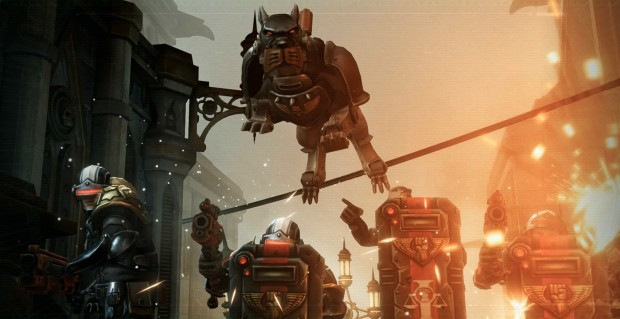
Glaito is the goodest boy... as long as he's not chasing you anyway!
Familiars and fights
After all, he also has a dog! ...a dog you sadly can't get even if you choose the new Overseer archetype. It's not too bad, though, as you get some bizarre, but very useful, Familiars instead: a Cyber-Eagle, a Psyber-Raven or a Servo-Skull Swarm.
Solomorne's Glaito is a line-breaker that loves to chew through snipers and backline casters. The Cyber-Eagle is fragile, but hits like a truck if you can line up a good attack. The Psyber-Raven amplifies a psyker's powers and spreads them to nearby targets. And the Servo-Skull Swarm is all about buffing allies, debuffing enemies, and generally being a big ol' nuisance.
The Familiars are not full party members, but their impact can still be huge. This is because they primarily use their master's action points for their abilities - and those don't count as attacks! So you can have Glaito first soften someone up, and then follow up with Solomorne to smash them into a wall with a shotgun blast or a big ol' shield. And that? That's a lot of damage!
They're a fantastic addition to the roster. Maybe slightly overtuned, sure, but you won't hear me complain as many of the DLC fights were quite tough. Even on Daring, which is just one step above Normal, I was regularly losing party members. That's not a complaint either, by the way - quite the opposite. I may be a bit rusty, but I really felt like the combat throughout Lex Imperialis hit a sweet spot. Not too easy, not too punishing, but rather just enough to be really entertaining.
Unlike some of the missions from the main campaign, there's also no filler here. You're never just fighting four random thugs loitering in the middle of the street. Nearly every encounter has some interesting setpiece or mechanical twist you have to work around. My favorite? A fight where I was hopelessly outnumbered... but had access to a massive tank! The whole battle revolved around keeping the tank operational, cutting off enemy reinforcements, and naturally, turning wave after wave of lunatics into a delightful red mist.
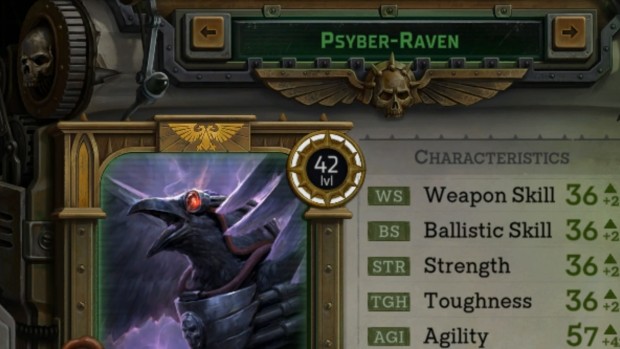
Psyber raven makes buff-focused psyker builds insane!
Story and its problems
Funnily enough, a lot of that action is wrapped up in a story that's a lot more grounded... at least at first. Since it revolves around the Adeptus Arbites, much of the early focus is on safeguarding the Imperial tithe - a megatax that every planet has to pay in both resources and manpower. It's the kind of bureaucratic nightmare that sounds very dull and dry, and for a little while, I was genuinely worried.
But credit where it's due - Lex Imperialis doesn't stay grounded for very long. After one mission you'll already be knee-deep in classic Rogue Trader nonsense: strange cults, shady conspiracies, moral dilemmas, and bizarre events that I'd love to talk about, but sadly can't because of spoilers. What I can say is that once the DLC gets going, it really hits all the right notes.
My favorite part? Visiting Thassera - a feudal world where society has regressed back to knights, castles and cobblestone streets. They've lost access to advanced technologies, and since they're not strategically important, the Imperium never bothered to come back and uplift them. So now you have this planet full of people living medieval lives while awkwardly trying to wield half-functioning Imperial tech they barely understand. It's a great contrast that really gives the world a fun and distinct flavor.
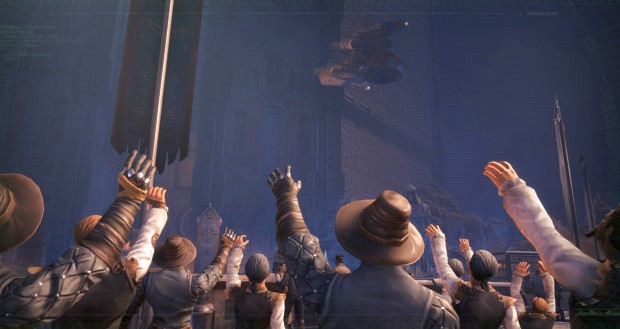
Thassera is such a weird but wonderful place
Thassera also happens to be the biggest chunk of the DLC, with a sprawling map full of interesting things to stumble upon and character to chat with. Once I got there, all of my early doubts melted away. The storyline that unfolds on Thassera is hinted at all throughout your time there, and while I won't spoil anything, I will say that it still managed to surprise me by the end.
Part of that surprise was also due to how quickly the story wrapped up - and that’s a pattern across the whole DLC. Each mission is set up well and pulls you into its own mini-narrative, but all of them feel like they're missing that extra thirty minutes to one hour to really let things sink in. This was especially true on the second planet. It set up a great premise, built some solid intrigue... and then just as I was getting into it, I was whisked away to a tiny room to make my final decision. It’s not a dealbreaker by any means, but it is a real shame because the stories in Lex Imperialis are strong. They just needed a bit more space to breathe.
Choices and consequences
Even if some of the story arcs feel a bit short, the choices you get to make along the way feel significant. Not all of them have immediate consequences, but many carry long-term implications, and that kind of weight has real roleplay value in my book.
What I don't know is how much the Heretical path diverges from the 'good guy' routes. Lex Imperialis takes place across four chapters which, if you've played the base game, you'll know is a lot of content, so there just wasn't time for me to replay everything from a Chaos-worshipper perspective. That said, I can easily see how the scenarios could unfold differently if you leaned into the role of a heretic, so hopefully it's as cool as it is in my head.
As for the actual writing that ties it all together, no surprises here, it's excellent across the board. It's sharp and intense when it needs to be. Surprisingly touching at times. And absolutely hilarious when it wants to be. If you're like me and you love poking around every corner and talking to every weirdo you find, you'll be happy to hear that Lex Imperialis rewards that curiosity with some great moments.
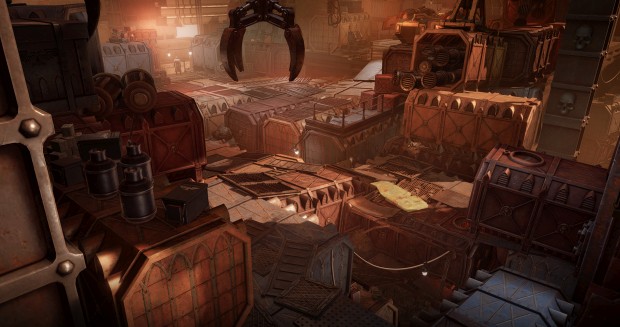
The DLC isn't all that massive, so take the time to explore everything. It's well worth it!
I especially love the courtroom segments, where the Adeptus Administratum tasks you with presiding over a series of ridiculous legal cases. These not only give you a range of clever, logical (and sometimes unhinged) options with interesting consequences, but they're also a perfect showcase of Imperial bureaucracy at its absolute worst. Did you know you can get executed if your family failed to go through the thirty-year process of registering your birth? Because in the eyes of the Administratum, if you don't have the paperwork proving you exist, you might as well be atomized - just to keep the ledgers nice and tidy! It's peak Warhammer 40k nonense, and I'd be lying if I said I didn't love every second of it!
I also have to praise the ending here. No spoilers, of course, but let’s just say that having to claw my way through a mountain of red tape to see justice done left me absolutely seething with rage. I haven't been this pissed off at a video game character in ages, but in a weird way, that's actually a compliment. It means I was so invested in the story that I took every brazen insult and smug lie personally. And that's the real magic of Owlcat's games. They're not just a collection of random fights and lore dumps. They actually make you feel things, good or bad, and that sort of thing sticks with you long after the credits roll.
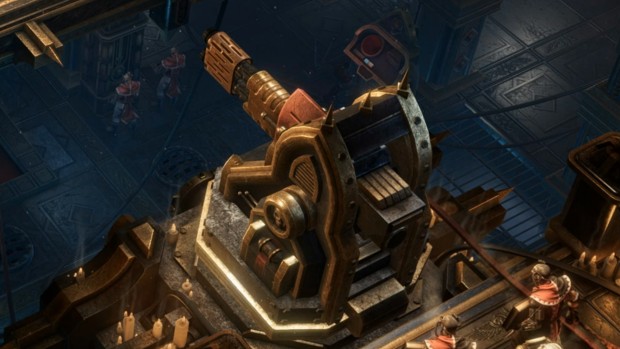
Nothing fills one with confidence like the gigantic court-cannon
Closing thoughts
While I would've loved for it to be just a bit longer, I had a great time with Lex Imperialis. And really, that's no surprise. It's more Rogue Trader, just with a higher production value and a tighter focus. So if you've enjoyed Owlcat's previous work, or if you're a fan of story-rich CRPGs in general, then I can comfortably recommend Lex Imperialis. And if you're not? Why in the world are you looking up a review for an RPG expansion?
One last thing, and this isn't part of the review itself - the Steam Summer sale is just around the corner. So if you're thinking of grabbing both of Rogue Trader's expansions, maybe hold off a few days and see if the Season Pass gets a discount. I've seen it hit 50% off before, so with a tiny bit of patience, you might snag a pretty solid deal. Enjoy!